

Overview of authentication methods on Blaxel
Blaxel employs two main authentication paradigms: short-lived tokens (OAuth) and long-lived tokens (API keys). Long-lived tokens are easier to use but are less secure as their validity can go from multiple days to infinite. They are generated as API keys from the Blaxel console. OAuth tokens are recommended for security reasons, as their duration is only 2 hours (short-lived). They are generated through OAuth 2.0 authentication endpoints.A personal API key or personal OAuth login grants access to every workspace your account belongs to, while a service account’s API key or client-credentials token only grants access to the single workspace that service account belongs to. If a request fails with a 403 error even though the credential is valid, this usually means the credential doesn’t have access to the specified workspace.
API keys
Long-lived authentication tokens are called API keys on Blaxel. Their validity duration can be infinite. API keys can be used in the Blaxel APIs, CLI and SDK. To authenticate in the SDKs, use the following two variablesBL_WORKSPACE and BL_API_KEY, which can be set in one of these sources:
- your
.envfile - your machine’s environment variables
- the local configuration file created when you log in through the CLI (see below)
Authorization or X-Blaxel-Authorization in any call to the Blaxel APIs. For example, to list models:
Use API keys in CI
GitHub Action
The easiest way to integrate the Blaxel CLI into a CI pipeline is with the official Blaxel GitHub Action. To use this, add a new secret to your GitHub repository namedBL_API_KEY and set it to the value of your Blaxel API key. You can then use the GitHub Action in a GitHub workflow, as shown below:
Manual configuration
If you prefer to set up authentication manually or are using a different CI platform, follow these steps:-
Set the API key as an environment variable in your CI environment:
-
Add steps to Download and install the Blaxel CLI in your CI environment and log in to your Blaxel workspace:
Use API keys via middleware
If you wish to call the Blaxel API directly from a client Web application, you would have to include your Blaxel API key in client-side code. This creates a serious security vulnerability, as the key will become visible in network requests or in the source code on the client end of the connection. The solution is to add authentication middleware between your client application and the Blaxel API. The middleware serves as a secure “translator”, which intercepts requests from the client application, injects your Blaxel API key, and then forwards them to Blaxel. This solution requires a catch-all route in the client application (e.g./api/blaxel) that forwards all SDK requests to Blaxel’s API. The route reads the Blaxel workspace and API key securely from host environment variables (e.g. BL_WORKSPACE and BL_API_KEY) and injects them into each request by adding Authorization and X-Blaxel-Workspace headers.
Here is a sample implementation of this catch-all route implemented in Next.js:
Manage API keys
You can create private API keys for your Blaxel account to authenticate directly when using the Blaxel APIs or CLI. Your permissions in each workspace will be the ones given to your account in each of them. API keys can be managed from the Blaxel console in Profile > Security.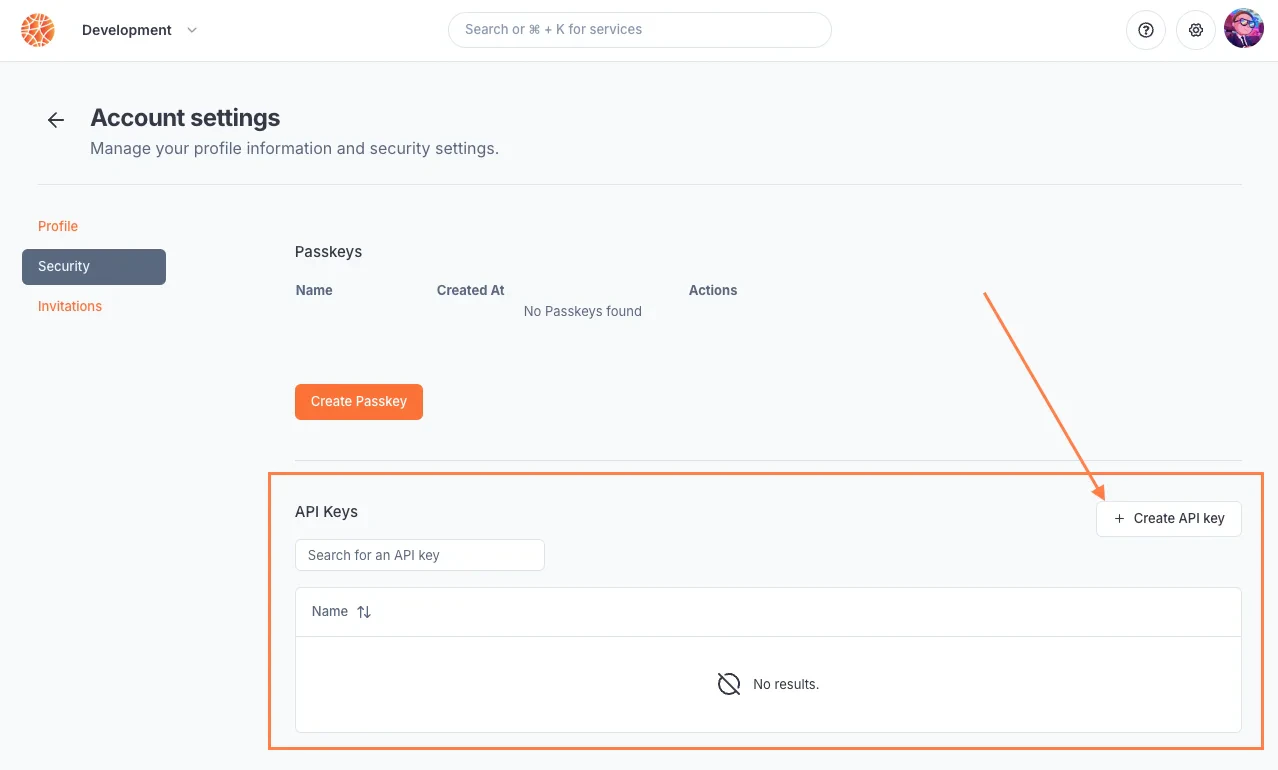
OAuth 2.0 tokens
These short-lived tokens are based on the OAuth 2.0 authentication protocol, and have a validity period of 2 hours.Use OAuth tokens in the CLI
Use thebl login command.
You will then be redirected to the Blaxel console to finish logging in. Sign in using your Blaxel account if you aren’t already.
Once this is done, return to your terminal: the login will be finalized and you will then be able to run CLI commands.
Use OAuth tokens in the API via service accounts
Service accounts can retrieve a short-lived token via the OAuth client credentials grant type in the authentication API, using their client ID and client secret. These two keys are generated automatically when creating a service account. Make sure to copy the secret at its generation as you will never be able to see it again after.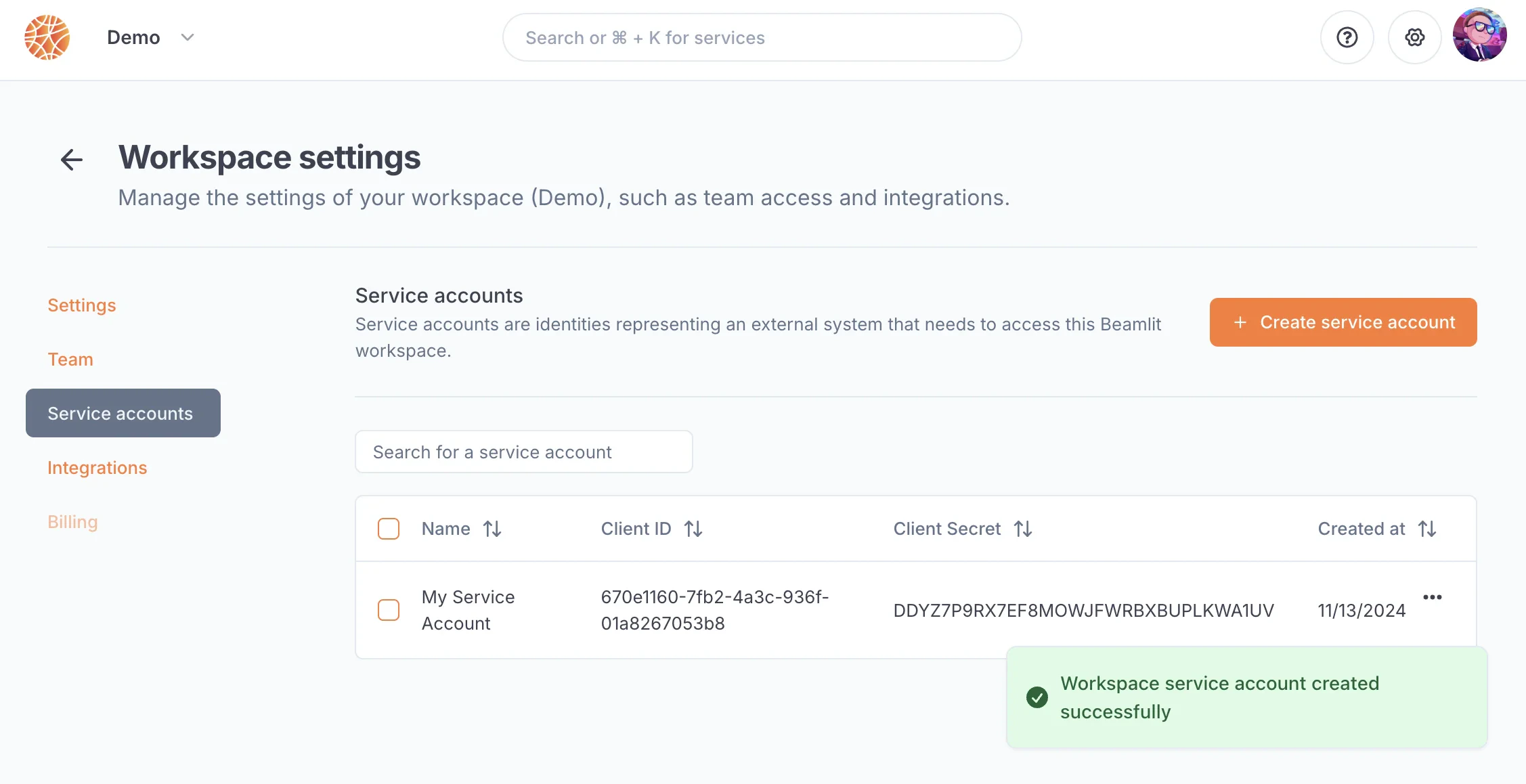
Service accounts can also connect to the API using a long-lived API key, as detailed in the section below.
/oauth/token endpoint.
Authorization or X-Blaxel-Authorization, as such:
Common errors: a missing or incorrect
grant_type value, or an invalid/missing client_secret, both return a 400 error describing the specific parameter that’s invalid or missing. Double check the client ID and client secret were copied correctly — the secret is only shown once at creation and can’t be retrieved again.(Advanced) Use OAuth tokens in the APIs
This section assumes you are a developer experienced with OAuth 2.0. For a simpler guide of how to use short-lived tokens in Blaxel APIs, read the section on authenticating service accounts.
Authorization or X-Blaxel-Authorization.
Alternatively, you can retrieve a token using the SDK: